
For many years, Emerson Waldorf School, like many other Waldorf schools around the world, marked the beginning of Autumn with a Michaelmas celebration. Our high school students offered a pageant recreation of Michael and the dragon, a story of courage in the face of darkness and a familiar image of a heroic figure confronting and vanquishing a threatening force.
This image is an enduring and compelling one. Autumn does indeed ask something greater of us. The days are shortening. The growing season turns toward decline. The leaves fall, the seeds harden. The animals prepare for a season of scarcity as the expansive life of Summer begins to withdraw. In the traditional image of Michael facing the dragon, we recognize a very human question – How do we meet that which frightens us?
And yet, over time it became clear to those of us in the high school that the Michaelmas imagery was no longer fully resonating with our students. Some felt uneasy with the explicitly Christian and European religious framework. However, more significantly, many students questioned the central narrative itself – the hero defeating the dragon. This narrative sees courage primarily through the lens of domination. Courage is the hero conquering the dragon, goodness defeating an external evil, a human or divine figure subduing something wild and dangerous.
For young children, this archetypal image can have tremendous imaginative power. However, by the time they reach high school, they regularly encounter complexity within historical narratives, world literature, ecological inquiry, and environmental justice cases. These encounters intentionally give them the tools and the inclination to question the categories themselves: What is the dragon? Who has decided that it must be killed? Is darkness necessarily evil? Is nature something that human beings must overcome? And is courage always expressed through victory?
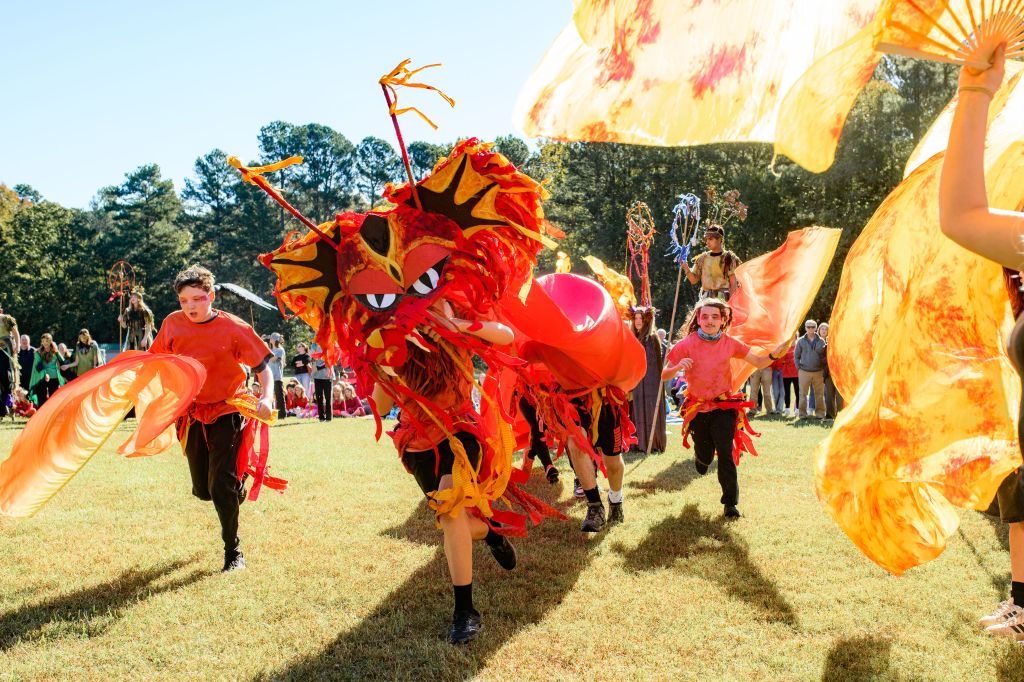
These questions and countless discussions led us to something new – The Festival of Courage.
This reimagined festival is not intended as a rejection of the Michaelmas tradition. In many ways, I see it as a return to the deeper question behind Michaelmas: What would an Autumn festival actually look like if we allowed it to arise anew, from our own time, our own young people, and the particular place on Earth where we live?
Steiner and the Impulse for a New Autumn Festival
Interestingly, Rudolf Steiner himself regarded an Autumn festival as something that modern humans would have to consciously create and recreate, not as something to inherit and reproduce.
In a lecture on May 23, 1923 on the seasonal festivals, Steiner imagined:
“that a number of open-minded people should come together for the purpose of instituting again on earth something proceeding out of the universe, as, for instance, a Michael Festival. This would be the worthy counterpart of the Easter Festival, but a festival taking place in autumn, an Autumn Festival. If people could determine upon something, the motive to which can be found only in the spiritual world, something which can kindle feelings of fellowship amongst those who assemble at such a festival—arising out of the fullness and freshness of the human heart through immediate contact—then something would exist which could bind men together again socially.”
Rudolf Steiner, “The Festivals and Their Meaning IV: Michaelmas”
Here Steiner is talking about bringing something into being. In this lecture, the festival is not merely a medieval tradition that modern schools should reenact. He imagines people gathering together to find a form adequate to their own age.
This distinction matters.
A living festival can’t just be an idea that we explain to our students. It has to connect their inner experience with something actually happening in the world around them: the season, landscape, community, human development. Once it stops doing this, it loses its power. Christmas and Easter gained their tremendous cultural power through layers of relationship between spiritual imagination, agricultural life, astronomical cycles, and seasonal experiences of death, birth, and renewal.
What then could an Autumn Festival become for us in these times?
I took inspiration from another Steiner passage. In a lecture given on January 13, 1924, Steiner made the remarkable claim that modern natural science should not be the enemy of spiritual perception. Instead, knowledge of nature should become its starting place. He says:
“What we need is a state of enhanced consciousness. Then, with the knowledge of Nature which we acquire, we can press into the higher world; and the Nature-knowledge we have acquired emerges and comes towards us from that higher world. We read again what has been written in the astral light; and as we do so, it emerges and comes to meet us in spiritual reality. We carry up into a spiritual world the knowledge of Nature here attained, or again, the creations of naturalistic art, or the religious sentiments working naturalistically in the soul. (Even religion has become naturalistic nowadays). And as we carry all this upward—if we develop the necessary faculties—we do indeed encounter Michael.”
Rudolf Steiner – “The Tasks of the Michael Age.” Lecture VI in the cycle Rosicrucianism and Modern Initiation
Just before this, Steiner is even more clear: “Learn first by Natural Science to know the properties of air, water, and earth.”
For me this is a profound pedagogical invitation. Perhaps we don’t have to begin with a spiritual story, with its inevitable cultural baggage, and then attach nature symbolism. Perhaps we can begin with nature itself.
Beginning with a Story of Place
Our school does not stand in medieval Europe. It stands in the North Carolina Piedmont. This matters (and very well may be the source of the dissonance that our students were feeling).
The North Carolina Piedmont is an ancient, weathered landscape in the meeting place between the Coastal Plain and the Blue Ridge Mountains – a mosaic of forests, streams, fields, farms, roads, towns, and rapidly developing cities. Our upland forests contain oaks, hickories, and pines; wetter, richer forests also support tulip polar, beech, and other determined hardwoods.
But the forest we see today isn’t untouched “natural” landscape. For thousands of years, the Piedmont has been shaped by disturbance, climate, animals, and human beings, including Indigenous peoples who deliberately used fire to shape the land.
Scientists increasingly recognize fire as an important ecological and historical force in Piedmont ecosystems. Fire-adapted prairies and open savannas once occupied portions of our landscape many of us now experience as closed forest. Historical and ecological evidence suggests that Indigenous burning practices, along with naturally occurring fires, helped maintain these open habitats.
And fire complicates our simple categories – Fire destroys AND fire creates.
We know that fire consumes dead material and living tissue. It can kill plants and animals and blacken a landscape. But in fire-adapted ecosystems, it can also open up the forest floor to life-giving sunlight, release nutrients, renew the soil fertility, encourage oak and pine growth, and increase the abundance and diversity of herbaceous plants.
A burned landscape is not necessarily a dead landscape. Sometimes it is a landscape beginning again.
Fire, Water, and the Autumnal Equinox
This became one of the central ecological images threaded through the Festival of Courage.
Our celebration is near the Autumnal Equinox, when day and night stand in balance before the year tips toward the long darkness of Winter. The traditional Michaelmas pageant tends to place these forces in opposition: light against darkness, Michael against the dragon, good against evil.
But ecology offers us another possibility. What if we consider that the task of Autumn is not just to defeat the darkness but to learn to live within a dynamic balance?
Fire itself refuses to remain comfortably on one side of a moral binary. Too much fire can destroy and devastate. Too little fire can also harm an ecosystem, allowing dense woody growth to choke out delicate plants and diverse wildlife.
Fire is not good or evil. Fire is a relationship with change. And so is water.
Water is the great life-bearing presence of the Piedmont landscape. It rains, runs through creeks, saturates our soils, moves through roots and leaves, gathers in rivers and flows to sea. Without it, there is no forest. Water also resists easy categorization. Water both nourishes and erodes. It replenishes and floods. It cools the fire and carries sediment and nutrients, helping vegetation thrive that may one day burn.
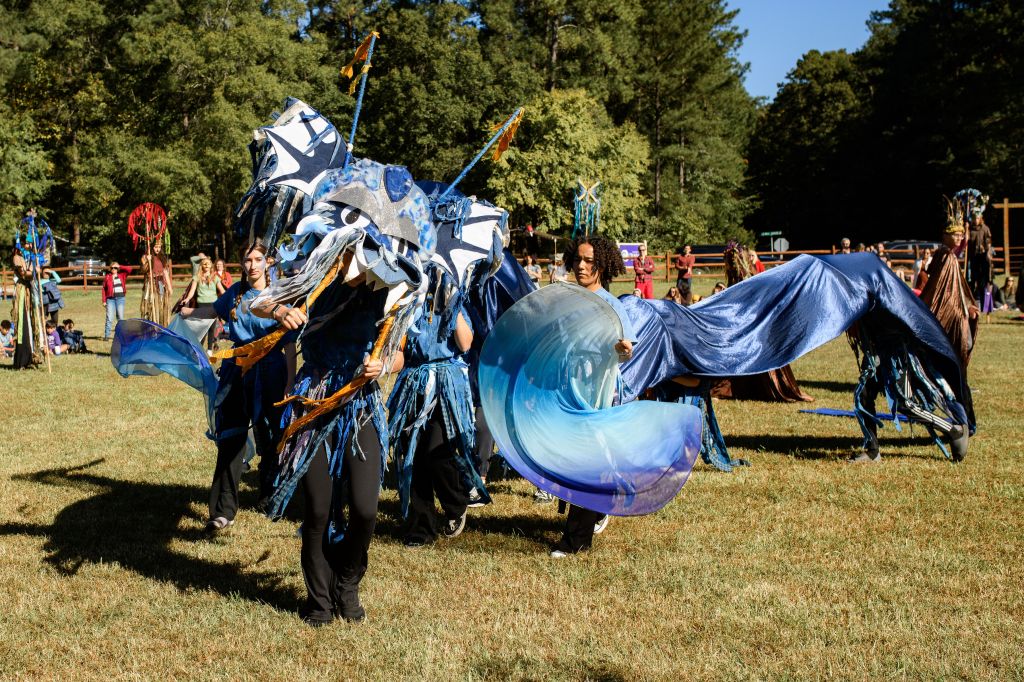
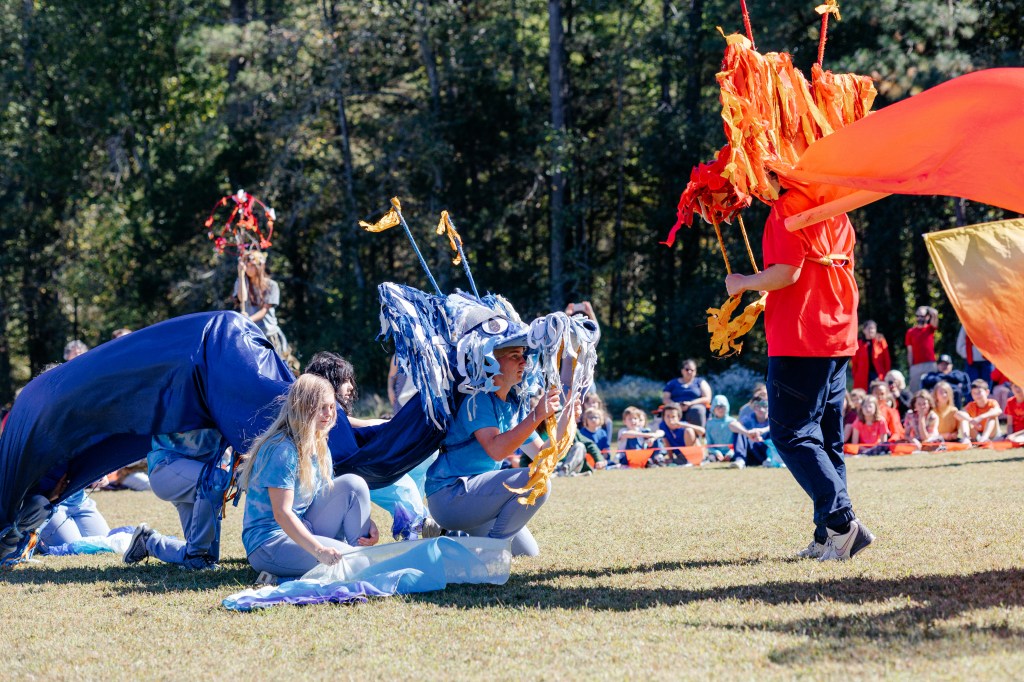
Our living landscape emerges not because one force triumphs over another, but because these two forces of fire and water meet, limit, transform, and balance one another. This imagination led us to two dragons.
Not one, But Two
The image of the dragon is, of course, much older and much larger than the Michaelmas story. In many European traditions, the dragon is a creature associated with threat, fire, chaos, treasure, and the underworld – a being to be confronted by a hero. The dragon-slayer becomes an image of civilization overcoming chaos and wildness.
But in East Asian traditions, I grew up with a very different dragon imagination. Dragons are strongly associated with water – with rain, rivers, clouds, and life-giving movement.
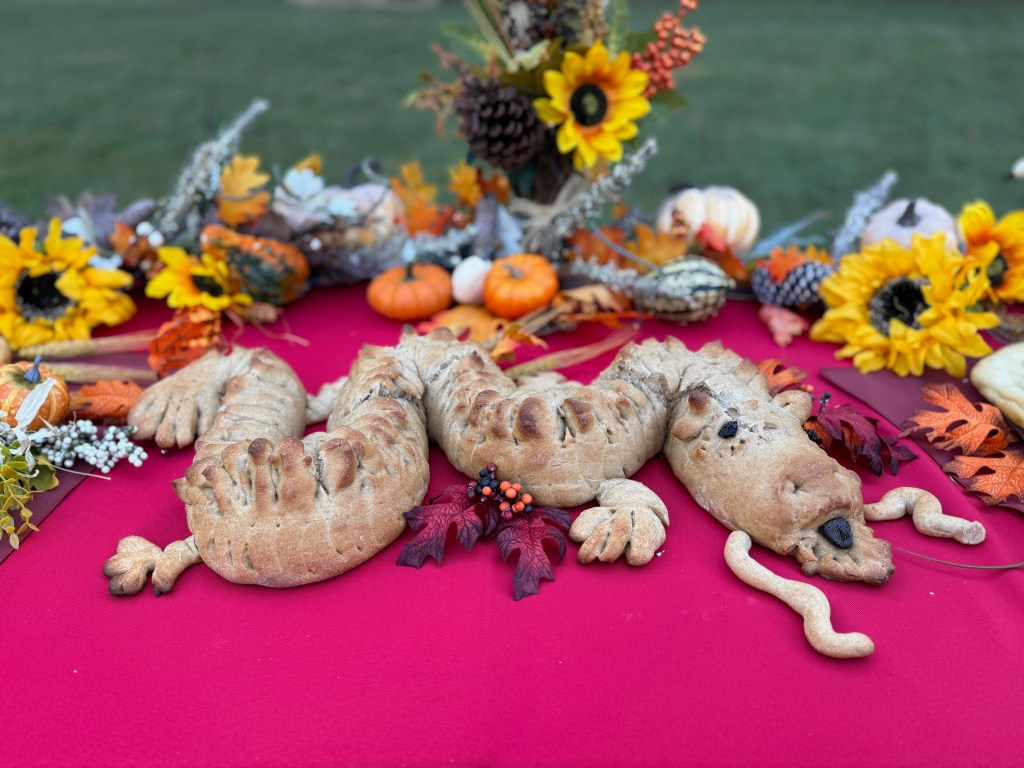
Bringing these two images together changes the story. Instead of Michael standing above a vanquished dragon, we can imagine the fire dragon and the water dragon intertwined – neither wholly good or wholly evil, neither ultimately victorious. In this meeting, there lies the possibility of balance. The story becomes less about domination and more about relationship:
Fire and water.
Darkness and light.
Growth and decay.
Activity and rest.
Humans and the more-than-human world.
Courage and vulnerability.
These are not problems we solve by eliminating one side. They are polarities that we must learn to inhabit, especially in our times. This is the work of the Consciousness Soul.
Autumn Does not Defeat the Darkness
This feels especially important at the Autumnal equinox, because if we take our cue from the season, Autumn does not tell a story about light defeating darkness. The darkness wins. At least for a while. Every evening arrives earlier. Photosynthesis slows down. Leaves senesce and fall. Annuals die. Insects retreat into the bark and soil and leaf litter. Seeds become dormant. Animals migrate or prepare for Winter scarcity.
Beneath all of that, the Earth dismantles what summer produced through the miraculous work of microorganisms and fungi. Fallen leaves become soil. Nutrients locked in one organism become available to another. Seeds wait. Ecologically, death is never just an ending. It is a transformation, making one life available to another.
This gives us a very different understanding of what it might mean to go into the darkness courageously. Courage does not mean we have to pretend that darkness is light nor that we have to push back the darkness. Courage asks us to enter the darkness knowing that we cannot yet see everything that is happening there until our eyes adjust. As the late Wendall Berry reminds us:
“To go in the dark with a light is to know the light.
Wendell Berry
To know the dark, go dark. Go without sight,
and find that the dark, too, blooms and sings,
and is traveled by dark feet and dark wings.”
Honoring the Living Beings Around Us
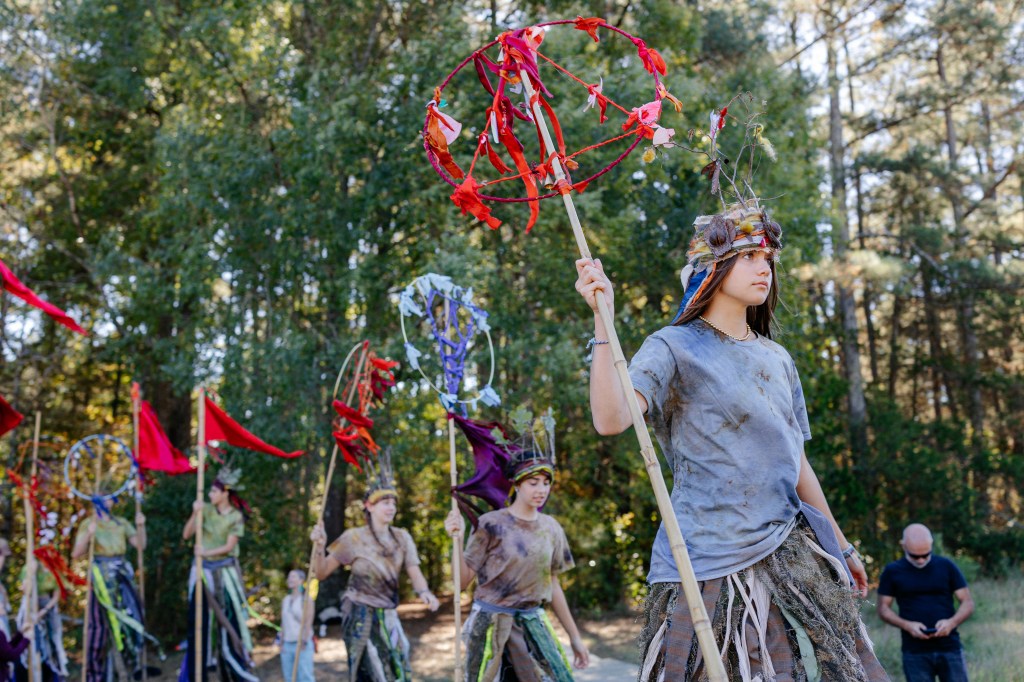
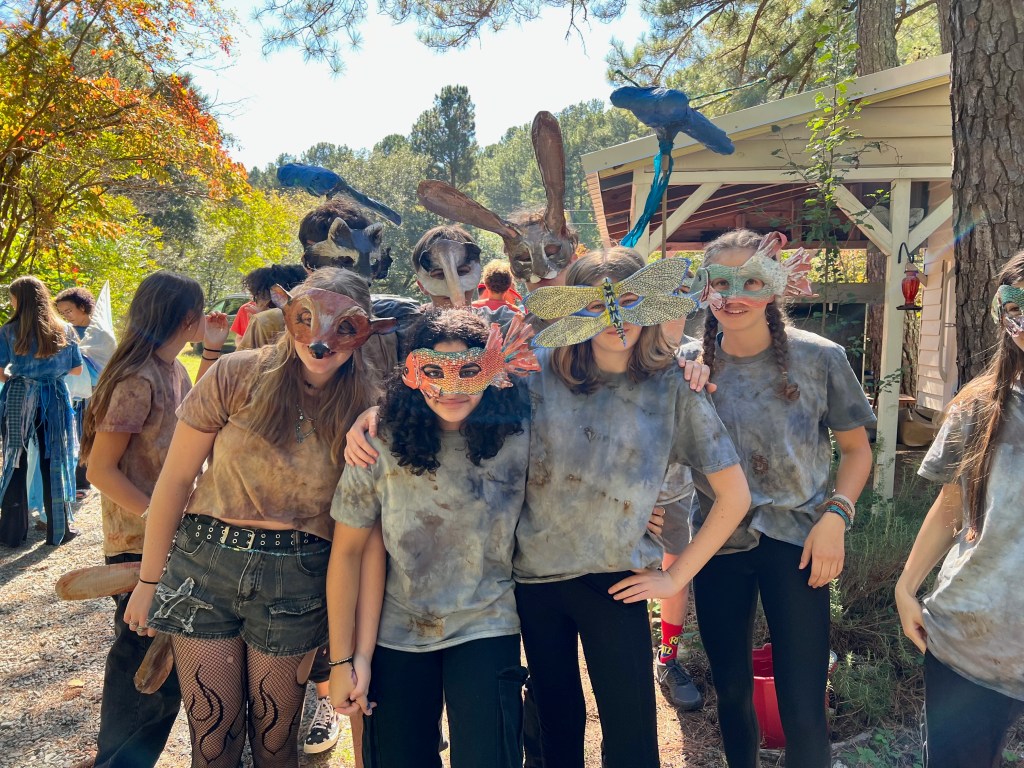
This is also why plants and animals have become such an important part of our Festival of Courage. If we imagine a festival informed by the season and the place where we actually live, then we need to notice who else is here. What are the oaks doing in October? Which birds are arriving and leaving? What happens to the creek after Autumn rains? Where are the insects going? This festival can become an act of attention. And attention is itself a form of reverence.
This is one place in which Steiner’s reminder about carrying our “knowledge of Nature” into spiritual life feels especially relevant to me in our modern context. We do not have to choose between ecological literacy and spiritual imagination. The careful observation of an oak, a river, a seed, a patch of wildflowers, or a migrating animal can become the beginning of a deeper spiritual inquiry. This activity is at the very heart of Waldorf education.
First we learn to see what is there. Then we ask what it means.
From Dominance to Relationship
As a phenomenologist, this change feels very significant to me. But there is also another reason why this matters. Our students are inheriting a world in which the consequences of a dominance- and conquest-based relationship with nature are increasingly difficult to ignore. They are growing up amidst climate disruption, catastrophic losses in biodiversity, habitat fragmentation, and profound questions about what kind of relationship human beings should have with the rest of the living world.
Against that backdrop, it feels necessary to reimagine a festival that has had as its central image a human-like hero standing triumphantly over the body of a defeated nonhuman creature, regardless of the metaphorical and spiritual intent.
I am more interested in asking our students whether courage might demand something more of us, something harder. Perhaps courage is knowing when NOT to conquer. Perhaps it is entering into a relationship with something we do not control. Perhaps it is protecting and honoring something vulnerable. Perhaps it is accepting limits. Perhaps it is enduring uncertainty and nuance rather than dividing the world into heroes and monsters. Perhaps it is recognizing that we are a part of a living community rather than standing above it.
This doesn’t negate the Michaelic question. I think it makes it more demanding. And more true to our time. How do we meet the forces of our time consciously and courageously?
A Festival We Have to Create Ourselves
If we return to Steiner’s imagination of an autumn festival for our time, the interesting question is not whether we, as a Waldorf school, can faithfully reproduce a Michaelmas celebration inherited from an earlier period of the Waldorf movement. Rather, the question is: What was Steiner asking us to create?
He describes an Autumn festival arising through human initiative, connected with the cosmos, and capable of generating fellowship. And his description of the Michaelic relationship to nature is remarkably embodied: we acquire knowledge of the natural world through our senses, work with it consciously, and bring something of our own activity toward the spiritual world.
Later in that 1924 lecture, Steiner describes Michael as the “spiritual hero of Freedom.” Michael, he says, does not simply supply us with instructions – what matters arises from human freedom and spiritual activity.
In this light, a Michaelic festival should perhaps not be something we are afraid to change. Maybe willingness to create it is part of the point.
This Festival of Courage is not, therefore, intended to be the final answer for what an Autumn Festival should look like. It is one offering – a story arising from these students, these teachers, this community, this moment, and this particular piece of Piedmont earth. Its images come from the equinox and the approaching darkness, from fire and water, forest and stream, decomposition and germination, animal and plant. They come from Eastern and Western dragon traditions placed into conversation rather than assuming one image to be universal. And they come from the conviction that young people can and should encounter difficult spiritual questions without being given predetermined answers.
We are still telling a story about Michaelic Courage. But courage no longer means raising a sword every time. Sometimes courage is carrying the flame or tending the water. Sometimes it is standing between forces that threaten to fall out of balance. Sometimes it is allowing something old to burn away so that something new can grow. And sometimes courage is simply walking together in fellowship toward the darkening part of the year, paying close enough attention to know that darkness, too, is alive.
Perhaps that is what an Autumn festival can offer our students right now – not an escape from the uncertainty of the world or a promise that every dragon can be slain, but an experience of meeting the world attentively, creatively, freely and together in fellowship. And perhaps each Autumn festival should leave us with the same questions: what does courage ask of us in this moment?
Sources and Further Reading
Rudolf Steiner, “The Festivals and Their Meaning IV: Michaelmas,” May 23, 1923.
This lecture is central to the idea that a Michael festival is something modern people must actively create out of a renewed understanding of the seasons, rather than simply inherit as a fixed tradition. It contains the passage about “open-minded people” coming together to institute an autumn festival and emphasizes its capacity to create fellowship.
Read the lecture at the Rudolf Steiner Archive
Rudolf Steiner, “The Tasks of the Michael Age,” January 13, 1924.
Especially relevant to the Festival of Courage is Steiner’s lecture on bringing our modern “knowledge of Nature” into spiritual consciousness.
Read “The Tasks of the Michael Age”
Rudolf Steiner, Michaelmas and the Soul-Forces of Man, September 1923.
In this lecture series, Steiner explicitly warns against simply adding a Michael festival to the calendar “with equal superficiality.” Something meaningful must actually happen in human consciousness to warrant the creation of a new festival. That passage strengthens the case for reimagining rather than mechanically reproducing Michaelmas.
Read Michaelmas and the Soul-Forces of Man
North Carolina Wildlife Resources Commission, “Piedmont Habitats.”
An excellent introduction to the actual ecological setting of the school: Piedmont oak forests, dry woodlands, floodplain forests, grasslands, shrublands, and early-successional habitats. Particularly useful is its discussion of periodic disturbance – including burning – and the historical role of Native American land practices in maintaining open habitats.
Explore Piedmont Habitats
North Carolina Wildlife Resources Commission, “Prescribed Fire.”
A good source for explaining why fire should not be understood simply as destruction. The Commission describes fire as a historical force in North Carolina landscapes and explains how prescribed fire can reset succession, recycle nutrients, stimulate grasses and wildflowers, and maintain wildlife habitat. It also explicitly recognizes both lightning and Native American burning as historical sources of fire.
Read about prescribed fire in North Carolina
North Carolina State Climate Office, “Fire History.”
This is particularly helpful for the human history of fire. It discusses evidence of historical wildfire as well as Native American controlled burning, including the use of fire after harvest to return nutrients to the soil. It also traces the later shift toward fire suppression and the eventual rediscovery of prescribed fire as an ecological management tool.
Read North Carolina’s Fire History
Piedmont Prairie Partnership, “Natural History.”
Especially useful if you want to go deeper into the idea that the Piedmont we see today is not necessarily the Piedmont landscape of the past. The site brings together historical and ecological research suggesting that prairies, savannas, and other open habitats were once more extensive and that both Indigenous burning and natural fire helped maintain them. It also provides a useful bibliography for further research.
Explore the natural history of Piedmont prairies
NC State Extension, “Using Fire to Improve Wildlife Habitat.”
If you’re interested in the practical ecology behind prescribed burning, this gives a more detailed account of how fire creates heterogeneous habitat, promotes groundcover, and interacts with oaks, hickories, shrubs, nesting sites, and wildlife.
Read the NC State Extension guide


Leave a Reply